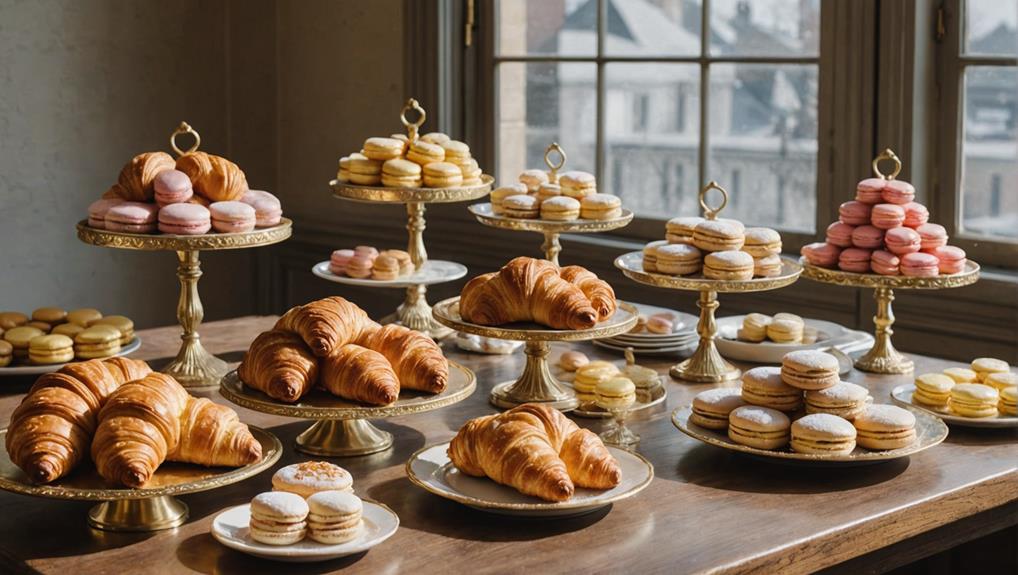
If you're looking to elevate your baking game, mastering classic French pastry techniques is a vital step. You'll discover how high-quality ingredients and precise tools can transform your desserts, and learn the ins and outs of dough preparation, temperature control, and more. But it's not just about following recipes; it's about understanding the underlying principles that lead to success. As you navigate through essential skills like piping and meringue variations, you might find yourself wondering how these elements come together to create iconic pastries. The journey is just beginning, and there's much more to explore.
Need cookware for your meal? Toolbox, a Pear to Pear rental marketplace, might be worth a look.
Quick Takeaways
- Master essential ingredients like high-quality butter, granulated sugar, and eggs for improved flavor and structure in pastries.
- Learn different dough techniques, including temperature control and ratios for pâte brisée and pâte à choux, to achieve perfect pastry textures.
- Develop piping skills by practicing various techniques and maintaining a consistent angle for uniform shapes in dessert decoration.
- Understand meringue variations, such as French, Swiss, and Italian meringues, for their unique textures and applications in desserts.
Essential Ingredients and Tools
To create classic French pastries, you'll need essential ingredients like high-quality unsalted butter, all-purpose flour, and fresh dairy products, along with specific tools that guarantee precision and ease in your baking process.
High-quality butter is essential, as it enhances flavor and contributes to a tender texture. Granulated sugar and eggs also play important roles in achieving the desired sweetness and structure.
When it comes to common tools, a stand mixer with a whisk attachment is indispensable for whipping meringues to perfection, while a rolling pin is essential for rolling out dough evenly.
A pastry scraper facilitates cutting and handling dough, making certain clean edges. For delicate pastries like macarons, a fine-mesh sieve is critical for sifting flour, helping to achieve a smooth batter free of lumps.
Baking sheets lined with parchment paper or silicone mats are necessary for even baking and easy removal of pastries. Additionally, tart pans with removable bottoms allow for elegant presentation.
Finally, investing in a kitchen scale guarantees precise measurements, which are crucial for the success of your classic French pastry recipes.
Mastering these ingredients and tools will elevate your pastry-making skills and impress your guests.
Mastering Dough Techniques
Mastering dough techniques is fundamental for achieving the perfect texture and structure in classic French pastries, where precision in handling ingredients can make all the difference.
Temperature plays a significant role; for instance, keeping ingredients cold is essential for achieving that flaky texture in puff pastry and shortcrust pastry. When making pâte brisée (shortcrust pastry), adhere to the 3:2:1 ratio of flour, fat, and water to guarantee a tender, crumbly result.
For pâte à choux, you must cook the dough on the stovetop before incorporating eggs, assuring a consistency that allows for proper rising during baking. Kneading is critical for developing gluten in bread dough, providing necessary structure, while folding techniques are employed in laminated doughs to create those coveted layers.
Don't overlook resting times—chill your pastry dough for at least 30 minutes. This step relaxes gluten, preventing shrinkage during baking and resulting in better shapes and textures.
Perfecting Piping Skills
Perfecting piping skills is vital for achieving professional-looking finishes on your classic French pastries, enabling you to create intricate designs with precision and flair.
Start by filling your piping bag about two-thirds full; this allows for easier handling and better control during the piping process. Before you fill the bag, verify the piping tip is securely attached to avoid any leaks, which can compromise your design.
When piping, use your dominant hand to apply pressure while your other hand guides the bag. This technique enhances your accuracy and stability, resulting in cleaner lines and shapes.
Practice various piping techniques, including straight lines, rosettes, and stars, to expand your repertoire and creativity in decorating your French pastries.
Maintain a consistent angle and distance from the surface to guarantee uniform shapes and sizes. This attention to detail is vital for creating visually appealing pastries that impress.
Understanding Meringue Variations
Understanding the different types of meringue is essential to enhancing your pastry repertoire, as each variation offers unique textures and applications in classic French desserts.
French Meringue is the simplest to make, utilizing egg whites whipped to soft peaks and combined with sugar, resulting in a light and airy texture. Just make certain your mixing bowl is free of fat for ideal results.
Swiss Meringue, on the other hand, involves heating egg whites and sugar together over a bain marie before whipping, yielding a silky consistency that's stronger than French but less stable than its Italian counterpart. This type is perfect for buttercream and delicate toppings.
Italian Meringue is the most stable, created by pouring hot sugar syrup into whipped egg whites. This method makes it ideal for mousses, tarts, and other desserts that require a firm structure.
When preparing meringue, remember that the sugar-to-egg white ratio is vital; a ratio of 2:1 guarantees you achieve stiff peaks without compromising stability.
Whipping Cream and Emulsions
Whipping cream, or Crème Chantilly, transforms into a light, airy topping when you whip it to stiff peaks, making it an indispensable component in many classic French desserts.
For delicate mousses, however, aim for very soft peaks to prevent overmixing, which can compromise texture. The ideal temperature for whipping cream is cold, allowing for maximum volume and stability.
Emulsions play an important role in pastry, as they involve combining fat and water-based substances seamlessly. Examples include rich ganache and smooth buttercream, where maintaining a balanced ratio is critical for achieving a velvety consistency.
When preparing ganache, gradually whisk melted chocolate and cream together, ensuring you manage the temperature to prevent separation.
If you accidentally overwhip your cream, don't worry. You can gently stir in a small amount of liquid cream to restore a smoother texture without losing volume.
This technique is indispensable, especially when preparing desserts requiring precision and finesse. By mastering whipped cream and emulsions, you'll elevate your pastry skills, ensuring your creations not only look exquisite but also deliver delightful textures and flavors that will impress your guests.
Baking and Rolling Tarts
Mastering the technique of baking and rolling tarts is essential for creating a flaky, delicious crust that serves as the foundation for various delectable fillings.
Start by chilling your tart dough; this prevents sticking and allows for a uniform thickness of about 0.5 cm (0.2 in). When you roll out the dough, lightly dust your work surface and the dough with flour. Be cautious not to use too much, as excess flour can toughen your pastry crust.
Once you've rolled the dough, carefully transfer it to the tart pan. To maintain the shape during baking, line the crust with parchment paper and fill it with weights or dried beans. This technique keeps the tart crust flat and prevents puffing.
After trimming any excess dough from the edges for a clean finish, it's time for baking. Pre-bake the tart shell at 350°F (175°C) until it's lightly golden. This step is vital to avoid a soggy bottom once you add your filling.
Chocolate Techniques for Pastry
In mastering chocolate techniques, you'll start with tempering, which requires precise temperature control to achieve that glossy finish and satisfying snap.
Next, you'll learn to create delicate chocolate curls, enhancing your desserts with both texture and visual appeal.
Tempering Chocolate Essentials
Tempering chocolate is a delicate process that requires precise temperature control to achieve a glossy finish and a satisfying snap.
Begin by melting your chocolate, paying close attention to the type you're using. For dark chocolate, aim for 45-50°C (113-122°F); milk chocolate should be melted to 40-45°C (104-113°F), and white chocolate to 38-43°C (100-109°F).
Once melted, cool the chocolate down to the appropriate working temperature by either letting it sit or using the seeding method. In the seeding method, add small pieces of solid tempered chocolate to the melted batch, which helps lower the temperature and promotes crystallization.
Use a thermometer throughout the process to guarantee accurate temperature control. A simple test to check if your chocolate is tempered correctly is to spread a small amount on parchment paper. If it sets quickly with a smooth, streak-free surface, you've achieved the desired temper.
Mastering tempering chocolate is essential for creating stunning finishes in your classic French pastry creations, enhancing both appearance and texture for a delightful experience.
Creating Chocolate Curls
Creating chocolate curls begins with properly tempering chocolate to guarantee stability and a smooth, glossy finish. Start by melting your chocolate until it reaches about 118°F (48°C), then cool it down to 82°F (28°C) before reheating slightly to around 88°F (31°C). This process stabilizes the cocoa butter, ensuring your curls set beautifully without streaks.
Next, spread the tempered chocolate onto a sheet of acetate or parchment paper in a thin, even layer. The thickness should be just right to achieve delicate curls. Once spread, use a pastry comb or a sharp knife to scrape the chocolate while it's still warm. This action allows it to form elegant curls as it begins to set.
For best results, let the chocolate curls rest at room temperature for at least 10 minutes. This time allows them to achieve a proper structure and glossy finish.
These curls can serve as stunning decorations for your French pastry creations, elevating dishes like chocolate ganache tarts. Store your curls in a cool, dry place to maintain their shape and texture, ensuring you make classic desserts that impress your guests.
Spraying Chocolate Techniques
Spraying chocolate involves mixing tempered chocolate with cocoa butter to achieve a fluid consistency that's vital for creating a smooth, even coat on your pastries.
For successful results in French baking, you'll need a handheld electric paint sprayer or a specialized chocolate sprayer. These tools allow you to evenly distribute the chocolate onto your frozen desserts, resulting in a unique, velvet-like outer shell.
Timing is important during the spraying process; apply the chocolate quickly to prevent it from solidifying before it adheres to the dessert surface. Aim for an ideal spraying temperature of around 30-32°C (86-90°F). This temperature guarantees proper flow and adherence without causing separation.
Before you tackle your final dessert, practice on parchment paper. This allows you to refine your technique and make any necessary adjustments, guaranteeing a smooth finish when it's time to serve.
Creating Classic French Desserts
Mastering classic French desserts requires a solid grasp of fundamental techniques, as each step greatly influences the final outcome and presentation.
Begin by understanding meringue types; French, Italian, and Swiss meringue each serve distinct purposes. For instance, Italian meringue adds stability to mousses and tarts, making it critical for your dessert's structure.
Next, focus on preparing a flawless tart crust using pâte sablée. Roll it to a precise thickness, ensuring you avoid shrinkage during baking. Once your tart shell is ready, fill it with rich pastry cream, a classic component that elevates many French desserts.
Don't forget about the finishing touches—tempering chocolate and creating ganache are essential for enhancing flavor and visual appeal. If you're assembling delicate pastries like éclairs or macarons, practicing your piping skills is important. Precision in piping affects both the texture and appearance of your creations.
Common Questions
What Are Common Mistakes to Avoid in French Pastry Baking?
When baking French pastries, avoid common mistakes like overmixing dough, mismeasuring ingredients, and neglecting temperature control. These errors can lead to dense textures, uneven baking, and less-than-perfect results that won't impress your guests.
How Can I Adapt Recipes for Dietary Restrictions?
You'll love how easy it is to adapt recipes for dietary restrictions! Just swap out ingredients like flour or sugar, and use alternatives like almond flour or agave syrup. Your guests won't even notice the difference!
What Is the Best Way to Store Pastries?
To store pastries efficiently, keep them in an airtight container at room temperature for short-term freshness. For longer storage, refrigerate or freeze them, ensuring you wrap each item tightly to prevent moisture loss and preserve texture.
How Do I Troubleshoot Common Pastry Issues?
About 30% of home bakers face pastry issues like soggy bottoms or uneven rising. To troubleshoot, check your oven temperature, guarantee accurate measurements, and allow proper cooling time. Adjust these factors for consistently delightful pastries.
Can I Substitute Ingredients in Classic French Pastry Recipes?
You can substitute ingredients in classic French pastries, but be cautious. Each ingredient plays a specific role; altering them may affect texture, flavor, and structure. Test small batches to verify your substitutions yield desirable results.
Wrapping Up
Now that you've explored classic French pastry techniques, you're equipped to create masterpieces in your own kitchen.
Did you know that mastering just three key techniques—dough, piping, and meringue—can elevate your baking skills considerably?
With practice, you'll find that about 80% of successful pastries stem from these foundational methods.
Embrace the art of pastry-making, and don't hesitate to experiment; each attempt brings you closer to perfecting your craft and delighting those who savor your creations.