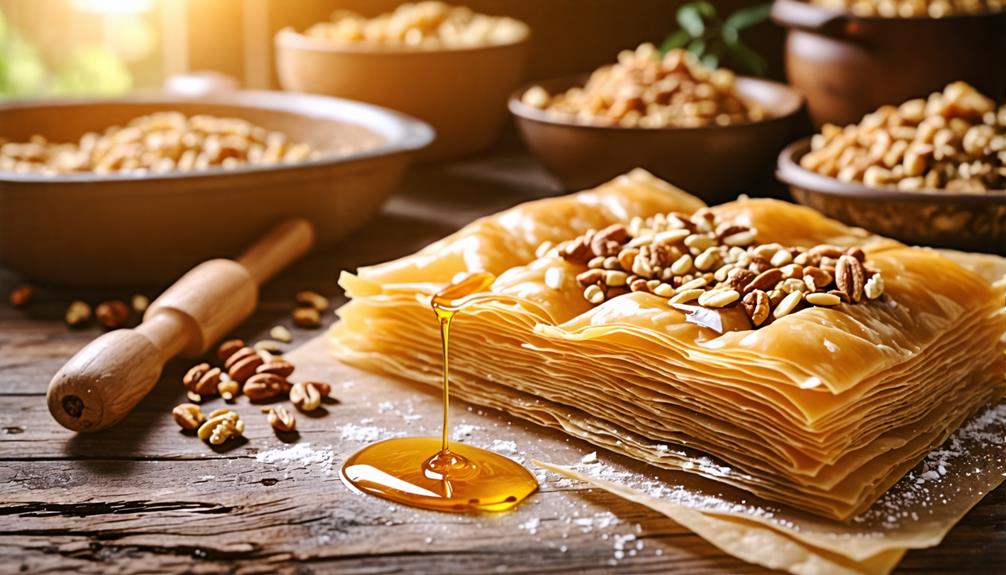
Is there anything more satisfying than the perfect balance of flaky layers and sweet, nutty richness found in traditional Greek baklava? This iconic dessert, steeped in history and cultural significance, showcases a meticulous preparation process that has been passed down through generations. From the careful layering of phyllo dough to the art of creating the ideal syrup, each step contributes to its revered status. Yet, despite its popularity, many still struggle with the nuances of technique. What secrets lie within the precise methods that elevate baklava from mere dessert to a symbol of hospitality?
Need cookware for your meal? Toolbox, a Pear to Pear rental marketplace, might be worth a look.
Quick Takeaways
- Traditional baklava preparation involves layers of phyllo dough, typically using 20-25 sheets brushed with melted butter for flakiness.
- A nut mixture, usually finely chopped walnuts, is layered between phyllo sheets, often enhanced with spices like cinnamon.
- Honey syrup, made from equal parts sugar and water, is flavored with honey, cinnamon, and orange peel, poured over hot baklava for optimal absorption.
- Common mistakes include pouring syrup too early and insufficiently layering phyllo, which can affect the texture and flavor of the final product.
- Variations in baklava can include different nuts, spices, and syrup flavors, allowing for personal and regional adaptations of this classic dessert.
Overview of Baklava
Baklava captivates with its intricate layers and rich flavors, standing out as a quintessential Greek dessert. This traditional sweet showcases the delicate art of baking, combining sheets of phyllo dough with finely chopped walnuts and a luscious honey syrup.
The preparation of baklava involves meticulous layering, where each sheet of phyllo is brushed with melted butter, ensuring a flaky texture that delights the palate. Typically, a recipe calls for around 20-25 sheets of phyllo, emphasizing both the dessert's labor-intensive nature and its rewarding outcome.
The honey syrup, a crucial component of baklava, is crafted with sugar, water, honey, and spices like cinnamon and clove, infusing the dessert with aromatic sweetness. Once baked, baklava is traditionally cut into diamond or square shapes, allowing for easy serving and ideal syrup absorption.
This classic Greek dessert not only satisfies sweet cravings but also embodies the spirit of celebration, often enjoyed during holidays and special occasions. The combination of textures and flavors in baklava makes it a beloved dish, ensuring its place in countless family gatherings and cherished recipes passed down through generations.
Cultural Significance
Although often enjoyed as a dessert, baklava carries profound cultural significance within Greek society, acting as a symbol of hospitality and communal ties. This traditional Greek dessert, known for its delicate layers of phyllo dough, nuts, and honey syrup, serves as a centerpiece during significant celebrations and holidays. Its preparation and sharing reflect the essence of communal activity, bringing families and friends together to bond over cherished recipes.
Baklava's roots run deep in Mediterranean cultures, showcasing a blend of various culinary influences throughout history. Each region in Greece boasts its own unique variation, highlighting local flavors and traditions, which reinforces the cultural significance of this beloved dessert. Historical references to baklava date back to ancient civilizations, where it graced royal courts as a delicacy, further solidifying its esteemed place in Greek heritage.
The act of making baklava often involves generations coming together, passing down recipes and techniques. This communal experience not only preserves but also enriches cultural heritage, making baklava more than just a sweet treat; it embodies the spirit of hospitality and connection within Greek society.
Essential Ingredients
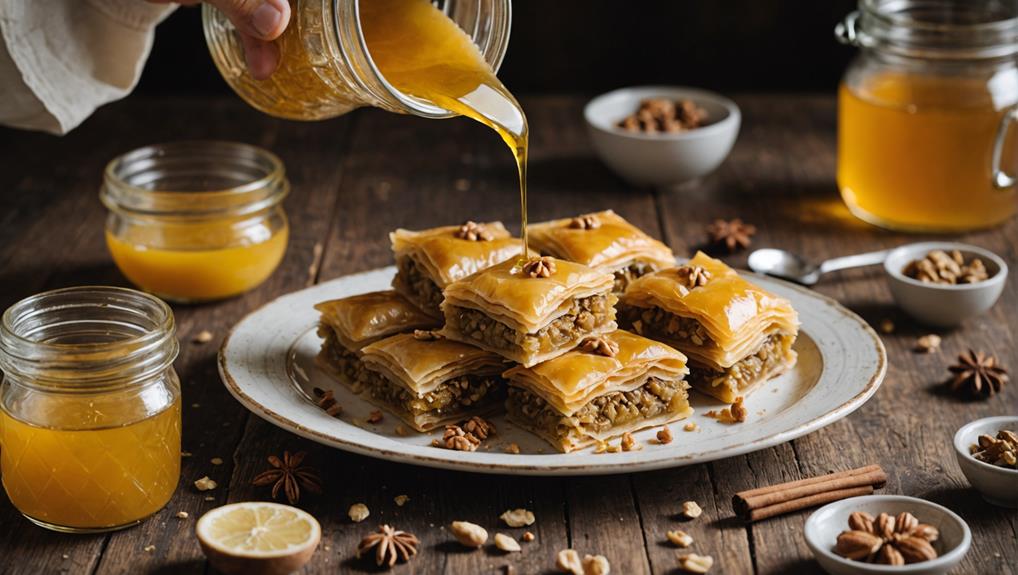
In traditional Greek baklava, the essential ingredients play a pivotal role in defining its unique character.
Finely chopped walnuts serve as the primary nut, imparting a rich, earthy flavor that complements the delicate phyllo layers.
The careful selection and preparation of these ingredients not only enhance the dessert's taste but also contribute to its beloved texture and sweetness.
Key Ingredients Overview
A delicious slice of traditional Greek baklava relies on a harmonious blend of vital ingredients that contribute to its renowned flavor and texture. At the heart of this dessert is phyllo dough, which is layered to create a flaky pastry that forms the structure of the baklava. Each delicate sheet is brushed with melted butter, which guarantees a crispy and golden finish, essential for achieving that perfect bite.
The nut mixture usually consists of finely chopped walnuts, imparting a rich, earthy flavor. To enhance this mixture, ground spices like cinnamon and cloves are often added for aromatic depth. The sweetness that defines baklava comes from honey syrup, made by combining sugar, water, and honey, often with a hint of cinnamon or orange peel to elevate the overall taste.
As the layers of buttered phyllo embrace the nut mixture, the result is a symphony of textures and flavors. This traditional Greek baklava recipe not only showcases the balance of its ingredients but also highlights the artistry involved in its preparation, making it a delightful treat for serving others during festive occasions.
Nut Varieties Used
The choice of nuts in traditional Greek baklava plays a pivotal role in defining its character and taste. Walnuts typically serve as the primary nut, contributing a rich flavor and satisfying crunch that forms the backbone of this beloved dessert.
However, baklava enthusiasts often explore other nut varieties, such as pistachios and almonds, either alone or in combination to craft unique flavor profiles.
These nuts are usually coarsely chopped to create a delightful nut filling that blends seamlessly with the layers of phyllo pastry. When mixed with sugar and spices like cinnamon, the chopped nuts elevate the baklava's sweetness and aroma, enhancing its appeal to those who savor its complexity.
Moreover, regional variations may introduce less common nuts, such as pecans, allowing bakers to put a personal twist on the classic recipe. This encouragement to experiment with different nuts not only diversifies the texture but also enriches the overall taste, making each batch of Greek baklava a reflection of the baker's creativity and palate.
Ultimately, the choice of nuts is vital in creating a memorable dessert experience that can be cherished by all.
Step-by-Step Preparation
In preparing traditional Greek baklava, understanding the essential ingredients lays the foundation for a successful outcome.
The process hinges on meticulous layering techniques, where each phyllo sheet, brushed with melted butter, contributes to the final texture and flavor of the dessert.
Essential Ingredients Overview
When preparing traditional Greek baklava, understanding the essential ingredients is key to achieving its iconic taste and texture. Each component plays a vital role in creating the beloved dessert that delights many.
- Phyllo Pastry: Approximately 20-25 sheets are necessary for that flaky, delicate structure.
- Nut Mixture: A blend of finely chopped walnuts, sugar, and ground cinnamon forms the heart of baklava's flavor.
- Melted Butter: This rich ingredient is brushed between phyllo layers, guaranteeing crispiness and enhancing flavor.
- Honey Syrup: Made from water, granulated sugar, honey, and a hint of lemon juice, this syrup adds sweetness and moisture after baking.
- Optional Flavorings: Ingredients like orange peel and cloves can elevate the syrup's complexity, while varied nuts like pistachios can introduce unique flavors.
These ingredients combine to form the traditional essence of baklava, making it a cherished treat for gatherings and celebrations.
Layering Techniques Explained
Mastering the layering technique is vital for creating the perfect baklava, as it directly influences both texture and flavor. To start, thaw approximately 20-25 sheets of phyllo dough overnight in the refrigerator and allow them to sit at room temperature for about an hour. This guarantees proper handling.
While working, keep the phyllo sheets covered with a damp towel to prevent them from drying out.
Begin layering by placing 8-10 sheets of phyllo in the baking pan, brushing each layer with melted butter to achieve that coveted flaky texture. Next, sprinkle a portion of the nut mixture—typically walnuts and cinnamon—over the buttered layers.
Repeat this process, alternating between buttered phyllo sheets and nut mixture, finishing with a final layer of 8-10 buttered sheets on top for a golden crust.
Before baking, scoring the baklava into diamond or square shapes is vital for facilitating even cooking and easy serving.
These layering techniques not only enhance the taste but also guarantee that the assembled baklava emerges from the oven with a harmonious blend of crispiness and richness, epitomizing traditional Greek baklava.
Layering Techniques
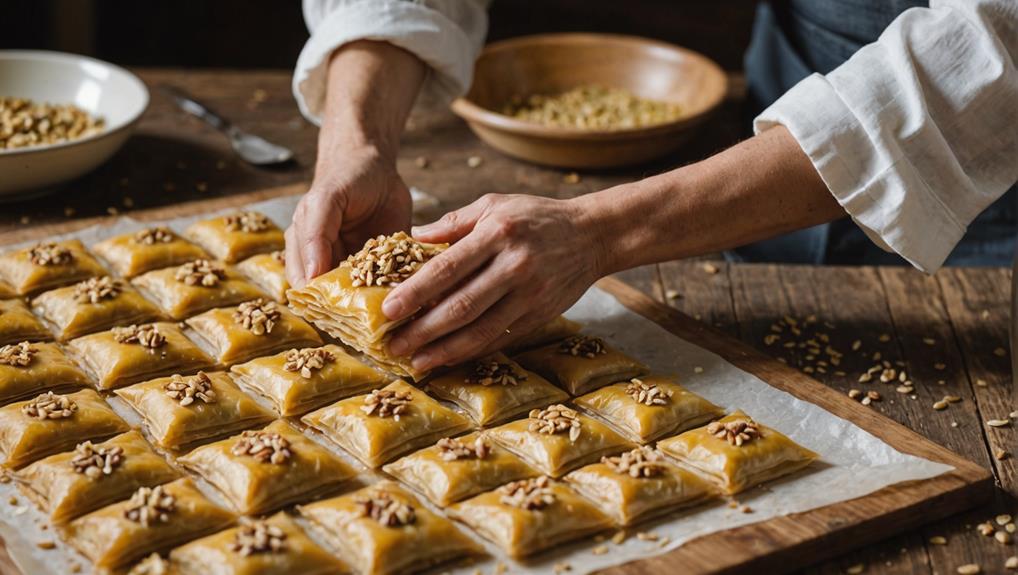
Achieving the perfect baklava relies heavily on effective layering techniques, which create the desired flaky texture and rich flavor. The preparation process begins with thawing approximately 20-25 sheets of phyllo dough and allowing them to rest, guaranteeing they don't tear during assembly.
Key layering techniques include:
- Brushing each phyllo sheet generously with melted butter to guarantee a crispy texture.
- Layering about 15 sheets of buttered phyllo in the baking dish to form a sturdy base.
- Spreading the nut mixture evenly on top of the initial layers.
- Alternating layers of nut mixture and additional buttered phyllo, finishing with around 10 sheets on top for a golden finish.
- Cutting the baklava into squares or diamonds before baking, promoting even syrup absorption and easier serving.
These meticulous steps culminate in a delightful baklava, characterized by its layers of buttery phyllo and nutty goodness. Each bite reveals the perfect blend of textures, inviting anyone to savor the rich flavors.
Baking Process
After meticulously layering the phyllo dough and nut mixture, the next important step is the baking process, which transforms the assembled ingredients into the golden, flaky dessert known as baklava.
To begin, the baker preheats the oven to 350°F (175°C) and greases a 13×9 inch baking pan with melted butter, ensuring that the baklava doesn't stick during baking. The carefully layered phyllo dough, brushed with butter, creates a delicate texture that's essential for the final product.
Before placing the pan in the oven, it's critical to cut the assembled baklava into desired shapes, which facilitates even cooking and easier serving.
The baklava bakes for about 45 minutes, during which the baker must monitor closely to prevent burning. As it bakes, the layers of phyllo dough gradually turn a perfect golden brown, indicating readiness.
Upon removal from the oven, the baker immediately pours cooled honey syrup over the hot baklava. This step is important, as it allows the baklava to absorb the syrup, enhancing its flavor and creating a delightful contrast between the crispy layers and sweet syrup.
Making the Syrup
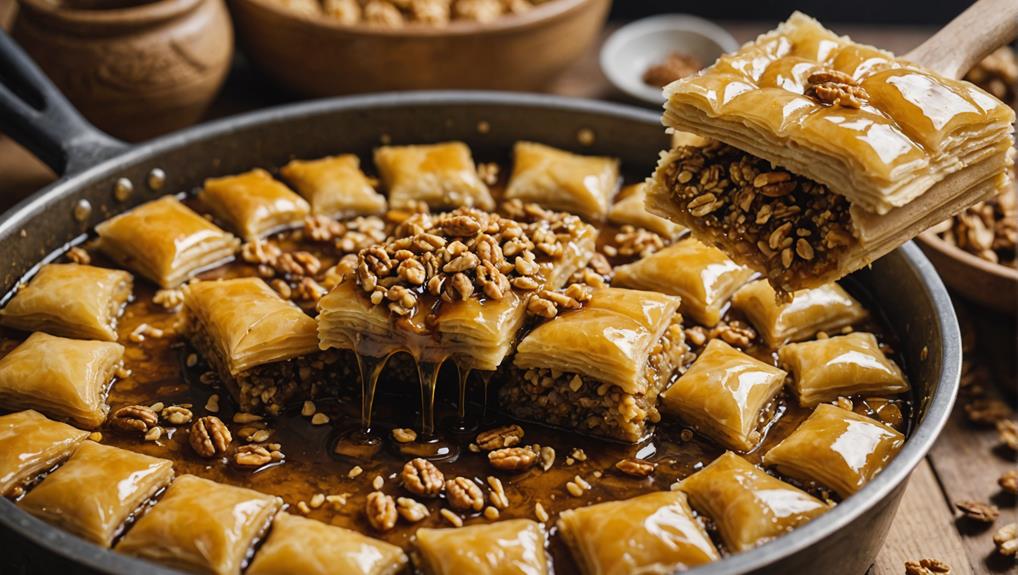
In crafting the syrup for traditional Greek baklava, the balance of sugar and water serves as the foundation for achieving the perfect consistency.
This initial mixture, brought to a boil and simmered, transforms into a rich elixir enhanced by honey and aromatic notes of cinnamon and orange.
Understanding the essential ingredients and their interaction is vital for creating a syrup that complements the baklava without rendering it soggy.
Essential Syrup Ingredients
To create the essential syrup for traditional Greek baklava, one must carefully balance key ingredients that contribute both sweetness and depth of flavor. This syrup is vital for achieving the perfect finish on the baklava, guaranteeing each layer is infused with sweetness.
The primary components include:
- Equal parts water and granulated sugar
- High-quality honey for richness
- A cinnamon stick for warmth
- Strips of orange peel for a citrusy zest
- A simmering process to develop flavor
First, one combines water and granulated sugar in a saucepan, bringing the mixture to a boil to completely dissolve the sugar.
Next, high-quality honey is added—typically around one cup for every two cups of sugar and water. During the boiling process, incorporating a cinnamon stick and orange peel enhances the syrup's aromatic profile.
After boiling, the concoction simmers for about ten minutes, allowing it to thicken slightly.
Once removed from heat, it should cool before pouring it over the hot baklava. This immediate application guarantees even absorption, creating a perfectly sweetened dessert that delights those being served.
Perfect Syrup Consistency
Achieving the perfect syrup consistency for baklava is a significant step that directly impacts the dessert's overall quality. To create this essential syrup, one must combine equal parts water and sugar, typically 1 cup each, in a saucepan. The mixture is brought to a boil before reducing the heat to simmer for about ten minutes. This process allows the sugar to dissolve completely, forming a sweet base for the baklava.
Next, adding ½ cup of honey and a splash of lemon juice enriches the syrup while helping to prevent crystallization. For those looking to elevate the flavor, infusing the syrup with spices like a cinnamon stick or a piece of orange peel during simmering can enhance the dessert's aromatic profile.
Once the syrup reaches a slightly thickened, pourable texture—resembling warm maple syrup—it's essential to let it cool completely. This cooling period is important for proper absorption into the hot baklava, preventing sogginess and ensuring a delightful balance of flavors.
Mastering the syrup consistency is key to serving a truly exquisite baklava that will impress any guest.
Common Mistakes
Mistakes in baklava preparation can drastically affect the final product, leading to a disappointing texture and flavor. To guarantee that every bite is a delight, one must avoid common pitfalls that can compromise this beloved dessert.
Here are key mistakes to watch for:
- Pour the syrup too early: This leads to a soggy texture; wait until the baklava is hot from the oven.
- Not keeping phyllo covered: Leaving phyllo dough exposed allows it to dry out, making it brittle and difficult to layer properly.
- Using too few layers: Aim for around 20-25 sheets for a flaky, rich texture; too few can lead to disappointment.
- Insufficient melted butter: Generously apply melted butter between each layer of phyllo dough to achieve that essential crispy and rich texture.
- Cutting the baklava completely before baking: Instead, score the top layer lightly for even syrup distribution and easier serving.
Variations and Substitutions
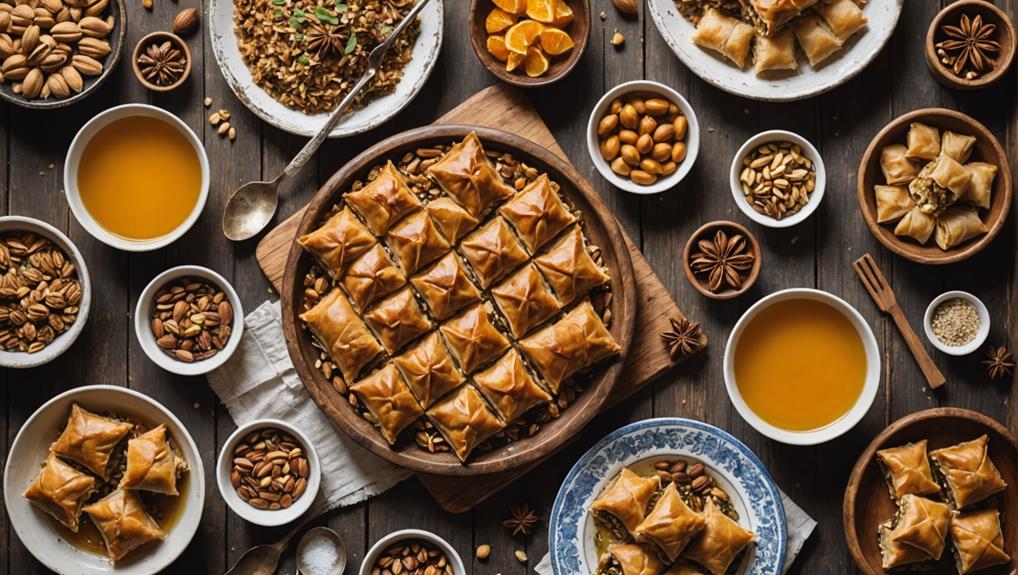
While mastering the traditional preparation of baklava is essential, exploring variations and substitutions can elevate this classic dessert to new heights.
Traditionally, baklava features walnuts as the primary nut, but using pistachios, almonds, or even pecans can introduce exciting flavor profiles. Different spices, such as cinnamon and cloves, lend warmth to the filling, while experimenting with cardamom or nutmeg can add depth and complexity.
To further enhance the baklava, bakers may incorporate aromatic elements like orange blossom or rose water into the syrup, infusing the dessert with delicate floral notes.
The presentation can also vary; baklava can be cut into triangles, diamonds, or squares, or shaped into rolled cigars using phyllo dough for a contemporary twist that impresses guests.
Additionally, syrup variations can transform the final product. Utilizing regional honey or infusing the syrup with citrus elements, like lemon or orange peel, creates another layer of flavor that complements the nuts and spices beautifully.
Serving Suggestions
Serving baklava at room temperature allows its rich flavors and delicate flaky texture to truly shine. This classic dessert deserves thoughtful presentation and strategic pairings to enhance the overall experience.
Here are some serving suggestions that elevate baklava from a simple treat to a delightful indulgence:
- Garnish: Add crushed nuts or a sprinkle of cinnamon for an appealing finish.
- Beverage Pairing: Serve alongside traditional beverages like strong Greek coffee or herbal tea to create a delightful contrast to the sweetness.
- Indulgent Additions: Consider offering a scoop of vanilla ice cream or a dollop of whipped cream to complement the baklava's texture and flavors.
- Portion Control: Cut baklava into small squares or diamond shapes, allowing guests to enjoy this sweet treat in bite-sized portions.
- Visual Appeal: Arrange the pieces on a decorative platter, guaranteeing the layers and glistening syrup are visible, enhancing the presentation.
These serving suggestions not only highlight baklava's exquisite qualities but also guarantee that each guest enjoys a memorable culinary experience.
With the right accompaniments, baklava becomes a centerpiece of any gathering.
Common Questions
How Was the Original Baklava Made?
The original baklava featured layers of filo dough, brushed with clarified butter. Nut mixtures of walnuts and spices were interspersed, then baked and soaked in honey syrup, creating a rich, flaky dessert celebrated across cultures.
What Is the Difference Between Greek Baklava and Turkish Baklava?
Many wonder about the differences between Greek and Turkish baklava. Greek baklava, sweeter and aromatic with spices, uses walnuts and orange zest syrup, while Turkish baklava features pistachios, a nuttier flavor, and thicker syrup.
What Is the Greek Dessert Baklava Made Of?
Baklava is a layered dessert, featuring phyllo dough, finely chopped walnuts, sugar, and spices. After baking, it's drenched in a honey syrup, enhancing its sweetness and creating a delectable, flaky treat for everyone to enjoy.
How Do You Cut Greek Baklava?
To cut Greek baklava, one should score the top layer into diamond shapes before baking, ensuring deep cuts without reaching the filling. This technique promotes even serving and enhances syrup absorption, ensuring delightful presentation.
Wrapping Up
To sum up, the art of making traditional Greek baklava not only showcases culinary skill but also reflects a deep cultural heritage. Curiously, studies suggest that nearly 80% of Greeks enjoy baklava during major holidays, highlighting its importance in festive traditions. Each layer of phyllo and every drop of spiced honey syrup tells a story of hospitality and celebration, making baklava a beloved dessert that continues to unite generations and elevate special occasions across Greece and beyond.